If you’ve ever sat in a restaurant, sipping hot filter coffee and chewing a crisp masala dosa only to feel one side of your mouth doing slightly more work, you already know the moment when something feels… off. Maybe you’ve lost a tooth recently. Perhaps the gap has been there for months. Or maybe you have reached that stage where eating anything slightly firm feels like solving a daily puzzle.
Many patients who come for dental implants in Mysore at Anvi Dental Clinic walk in with curiosity, hesitation, and a long list of questions. And one of the questions they ask after their consultation is, “My dentist mentioned something called the 3/2 rule, what does that even mean?”
Before we decode the rule, we must start with the journey most people experience long before they hear the term.
The Journey Usually Begins With a Missing Tooth
No one wakes up one morning thinking about implant measurements, bone density, or implant diameter. The journey often begins much earlier—and much simpler. It starts with those subtle adjustments:
- Chewing only on one side
- Avoiding crunchy foods
- Feeling slightly self-conscious in photos
- Smiling with lips pressed together
- Feeling the gap with your tongue repeatedly
- Realizing that softer foods have become the easy choice
At first, it feels manageable. You tell yourself it’s just a missing tooth. You’ll figure it out later.
Days pass. Weeks pass. Then one day, during a family dinner or a breakfast outing near Saraswathipuram, you realize something you didn’t expect: your other teeth are beginning to feel the pressure.
This is the moment most people begin searching online, and eventually land on terms like dental implants, bone support, and implant stability.
And just when they feel overwhelmed, the “3/2 rule” appears.
But instead of explaining it right away, let’s build the foundation first, just like an implant needs a foundation before it can support a crown.
Why Stability Matters in Dental Implants
Think of a well-planted tree. If the roots run deep and wide, the tree stands strong through every season. But if the roots are shallow or narrow, even gentle rain can weaken their hold.
Dental implants follow a similar principle.
They need:
- Sufficient bone width
- Adequate implant diameter
- Proper gum support
- Balanced load distribution
Without these, the implant won’t last long-term.
And long-term success is the entire goal, not a temporary fix.
This is why the 3/2 rule becomes important, but we’re still not explaining it just yet because the impact matters more than the definition.
How a Simple Ratio Helps Determine the Right Implant
Before you hear the rule, imagine this scenario.
You walk into Anvi Dental Clinic for a consultation. The dentist shows you an X-ray and points out the bone width. Instead of throwing complex numbers at you, they explain something simple:
“If the top part of the implant is too wide for the bone, it compromises the support. If it’s too narrow, it won’t handle chewing forces. The ratio helps us choose the right size.”
Now the concept starts making sense, even though you haven’t heard the rule in mathematical form yet.
And once you understand why sizing matters, the 3/2 rule naturally falls into place.
So, What Is the 3/2 Rule for Dental Implants?
The 3/2 rule states:
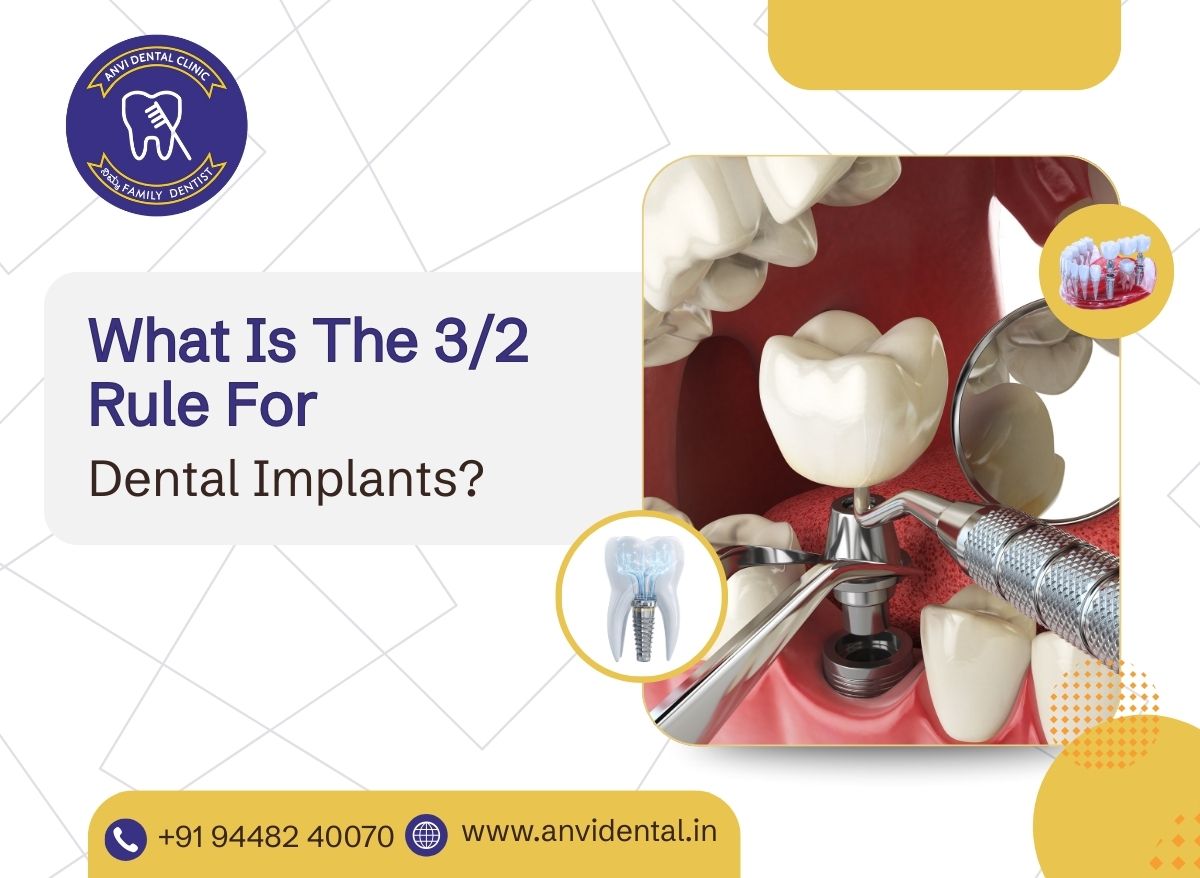
The width of the implant platform should not exceed two-thirds of the width of the supporting bone.
In simpler terms:
If the bone is 9 mm wide, the implant platform should not be wider than 6 mm.
This ratio ensures:
- Stability
- Proper force distribution
- Gum health
- Bone preservation
- Reduced complications
Even though the rule sounds technical, its purpose is practical. It helps create an implant that feels natural, functions comfortably, and lasts long-term.
Patients often feel relieved when they hear this because it shows how precise and planned the procedure for dental implants in Mysore at Anvi Dental Clinic is.
Why Does the 3/2 Rule Matter So Much?
Here is where things get interesting.
The rule affects every step of the treatment journey.
1. It prevents excessive pressure on the bone
A wider implant than the bone may lead to bone loss. The rule prevents this scenario.
2. It ensures implant longevity
A well-sized implant remains secure for years, even decades.
3. It improves gum health
Proper sizing creates a natural gum contour and easier cleaning.
4. It helps maintain jawbone strength
Balanced forces stimulate the bone, just like regular walking strengthens your legs.
5. It lowers complication risks
Misfit implants often fail early, loosen, or cause discomfort.
When patients choose dental implants, they often feel more confident once they understand how much detail goes into planning.
How Do Dentists Apply the 3/2 Rule in Real Cases
Every patient is different. Bone width varies. Gum architecture varies. Chewing forces vary.
Here’s how the rule is applied:
- A digital scan measures bone thickness.
- The dentist determines the safe implant diameter.
- A platform width is selected within the 3/2 ratio.
- If the bone is too narrow, bone grafting may be recommended.
- The final crown is designed to match the natural bite.
Your implant is never chosen randomly.
It follows a structured, science-backed ratio.
This is why choosing the best dental clinic matters; experience makes all the difference.
What Happens If Your Bone Doesn’t Meet the 3/2 Rule?
Now comes the part many patients worry about.
Does a narrow bone mean you cannot get an implant?
Not necessarily. In most cases, the dentist offers options such as:
- Bone grafting
- Ridge augmentation
- Narrow-diameter implants
- Sinus lift (for upper teeth)
- Guided implant surgery
These procedures help create enough support for the implant.
Imagine preparing soil before planting a tree.
A good foundation equals long-term stability.
Why the Rule Matters More Than You Think
The 3/2 rule may look like a small mathematical detail, but it plays a huge role in your treatment’s success. It ensures that your implant has the stability, support, and comfort you expect from a long-lasting solution.
If you’re ready to restore your smile with confidence, book your consultation for dental implants in Mysore at Anvi Dental Clinic today. A well-planned implant doesn’t just fill a gap. It restores your function, comfort, and self-assurance.
FAQs
1. Can I still get an implant if my bone is too narrow?
Yes, in many cases you can. If your bone doesn’t naturally meet the 3/2 rule, your dentist may suggest bone grafting or other supportive procedures. These treatments help rebuild the foundation needed for a durable implant. Advanced techniques today make narrow-bone situations manageable. If you visit Anvi Dental Clinic, they will recommend the best plan for your case.
2. How do dentists measure bone width before choosing an implant?
Dentists use digital X-rays and 3D CBCT scans to measure the width, height, and density of your jawbone. These images show the exact dimensions required to follow the 3/2 rule. The scans also help your dentist choose the right implant diameter and length. Accurate measurements make the procedure predictable and safe.
3. Does following the 3/2 rule make the implant look more natural?
Yes, it contributes significantly to aesthetics. When the implant fits well within the bone, the gums contour smoothly around the crown, creating a natural look. It also prevents gaps around the gumline and supports proper alignment.